

Market Monitor: July 2026
The second quarter of 2026 delivered a dramatic turnaround from the turbulence that opened the year. After the outbreak of the Iran war sent the S&P 500 down roughly 4.3% in the first quarter and closed the Strait of Hormuz to commercial traffic, global equities staged one of the sharpest recoveries in decades. A ceasefire agreement covering the Strait, an increase in oil exports from the U.S. and OPEC, and resilient corporate earnings fueled the rally. The S&P 500 surged 15.2% in the second quarter alone, its best quarterly showing since 2020, lifting the index to a 10.2% total return for the first half of 2026.
2nd Quarter Highlights
- U.S. equities staged a powerful rebound. The S&P 500 rallied 15.2% in the second quarter, erasing the first quarter’s losses and pushing the index to a 10.2% total return for the first half of 2026. Gains broadened out as the quarter progressed, with small-cap, mid-cap, and value benchmarks joining large-cap growth stocks at record highs by June.
- “Risk On” for Artificial Intelligence stocks. After a noticeable correction in Q1 attributed to market concerns over investment in AI infrastructure, Q2 saw rapid recovery and growth in the value of these technology companies along with some much needed breathing room for valuations.
- Corporate earnings continued to exceed expectations. Analysts now project second-quarter S&P 500 earnings growth of roughly 23% year-over-year, up sharply from the 19% estimate at the end of March, while revenue growth forecasts climbed from 9.5% to 12.3% over the same span.
- International markets kept pace with their U.S. counterparts. The MSCI EAFE Index returned approximately 9.4% for the first half of 2026, close to the S&P 500’s gain after leading U.S. stocks in the first quarter, a reminder of the diversification benefit non-U.S. holdings can provide.
- The Federal Reserve held rates steady but turned more cautious. The Fed kept its benchmark rate at 3.50% to 3.75% for a fourth consecutive meeting at its June 17th gathering. As of this writing on July 10, 2026, CBOE FedWatch data show a 36% probability of a rate hike between now and year end. With oil prices down, and assuming they remain at these lower levels, inflation pressure could ease in the months ahead, though the labor market, which has remained strong, will also play a meaningful role in shaping the Fed’s path. The 10-year Treasury yield finished the quarter at 4.42%, slightly below its high for the year of 4.67%. For reference, the Garde Capital investment committee anticipates one 0.25% increase in the Fed Funds rate during 2026 and expects the 10-year U.S. Treasury yield to end the year at 4.6%.
- The labor market has continued to show strength. Employment data has come in stronger than many had anticipated, and the widely expected wave of artificial intelligence driven labor force reductions does not appear to be materializing to the degree many predicted. The unemployment rate stands at 4.2%, and we continue to watch labor force participation and hiring trends closely as key inputs to the Fed’s policy path.
- Geopolitical risk eased, though the situation remains fragile. A 60-day ceasefire agreement reached in mid-June reopened the Strait of Hormuz to commercial traffic, and oil prices retreated sharply from their initial spike. We are slowly seeing an increase in shipping traffic through the Strait, though progress remains day to day and is highly dependent on the prevailing political climate.
- A new Federal Reserve Chair. Kevin Warsh’s Fed debut brought a leaner, more guarded communication style. Markets had braced for a less forthcoming Fed under the new chairman, and his first meeting delivered. Officials held the benchmark rate steady as expected, but Warsh broke with tradition by skipping the Fed’s “dot plot” and issuing a noticeably shorter policy statement. He reaffirmed the Fed’s commitment to its 2% inflation target as “strong, unanimous, and unambiguous,” while unveiling task forces across five areas of monetary policy that point to structural changes ahead.
Economy in Focus: S&P 500 Earnings Growth and Margin Expansion
The earnings of S&P 500 companies have continued to defy logic and gravity with another upward surge during the second quarter from an already high level. Estimates now show earnings growth of 24% for 2026 and 17% for 2027. While revenue growth has been a healthy contributor, profit margin expansion has been the key driver. The rapid buildout of AI infrastructure and associated capex spending among technology firms has given investors plenty to cheer about in the midst of geopolitical uncertainty and persistent inflationary trends.
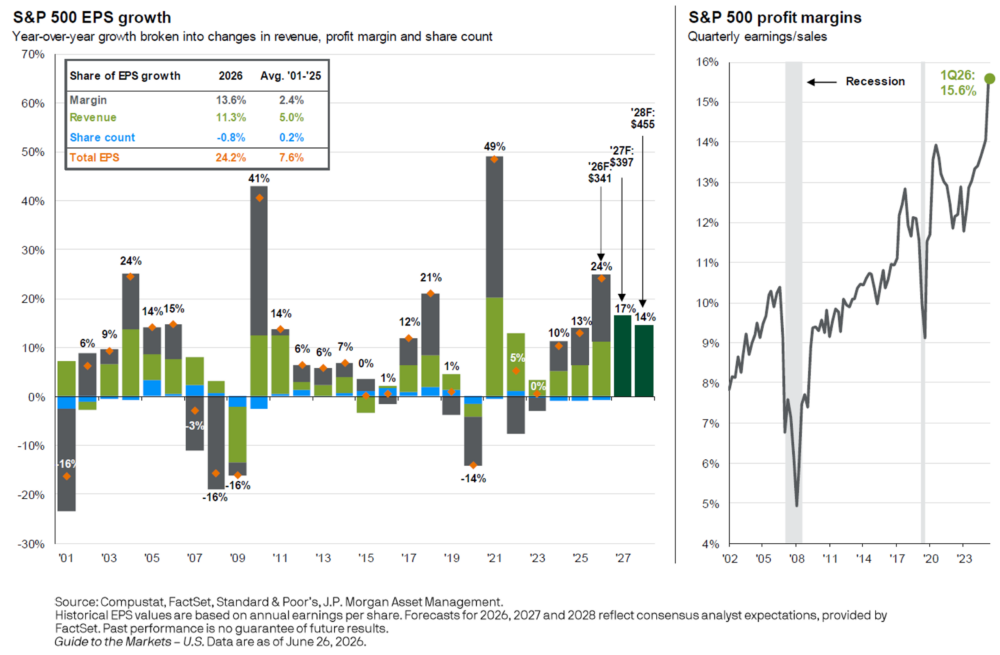
It is worth noting that much of the recent earnings strength has been concentrated in a handful of companies driving the AI infrastructure buildout, Micron and Nvidia among them. Since buyers of this equipment amortize the expense over time, current-period earnings may be somewhat inflated. The key questions ahead: what a sustainable, normalized capex level looks like once the buildout matures, what return on that investment ultimately materializes, and how consumer spending, which underpins those returns, holds up. We’re watching whether capex can continue at a pace that lets businesses earn an adequate return while consumers retain the income and confidence to keep spending.
Source: www.cboe.com/fedwatch, fred.stlouisfed.org, Morningstar Direct
Tech Tip: Beware of Voice Cloning
Voice cloning technology has made it possible for scammers to convincingly imitate a family member, colleague, or even your advisor using just a few seconds of audio pulled from social media or a voicemail greeting.
Action Item: If you receive an unexpected call, especially one asking you to send money, share account information, or change payment instructions urgently, hang up and call the person back using a number you already have on file, not one provided during the call.
As always, we are available as a resource on any of these topics. Please do not hesitate to reach out to us at any time with questions or concerns, and we look forward to connecting with you soon.
Please find this newsletter and others on our website at www.gardecapital.com.
This article was published by Garde Capital, Inc. a Seattle based Registered Investment Advisor that provides wealth management solutions to individuals and families, nonprofit organizations, and corporate retirement plans.
Copyright 2026 by Garde Capital, Inc.