

Market Monitor: October 2026
Investors were buffeted by numerous cross-currents in the third quarter of 2026, but there was also plenty of good news in the numbers. Equity markets remained resilient even as the Federal Reserve resumed raising rates for the first time since 2023 and the 10-year Treasury yield climbed to a 24-year high. Bond prices pulled back as a result, but that same move left fixed income investors with the most attractive new-money yields in a generation. Growth stocks led the way again this quarter, and stocks and bonds moved largely independently of one another, a reminder of the diversification benefits a balanced portfolio can offer. All eyes remain on the Federal Reserve as both consumer spending and inflation continue to rise heading into the U.S. elections in November.
3rd Quarter Highlights
- Stocks proved resilient again in Q3. The S&P 500 rose 2.3% in the third quarter, led once again by the growth segment of the market. The Vanguard Morningstar Growth ETF (VUG) rose 4.5% in the quarter while the Vanguard Morningstar Value ETF (VTV) was slightly negative, down 0.5%. For the year however, value stocks have increased 14.9% compared to growth stocks at 11.2%[1], a testament to the market breadth in this phase of the cycle.
- Interest rates surged to multi-decade highs, a silver lining for savers and bond buyers. The Federal Reserve raised its benchmark rate by 0.25% to a target range of 3.75%-4.00% at its September 16th meeting, its first hike since 2023, and signaled one more increase before year end. The 10-year U.S. Treasury yield climbed above 5.3%, a 24-year high. While that move hurt holders of existing bonds, it also means investors putting new money to work in high-quality fixed income can now lock in the most attractive yields in a generation, a meaningful opportunity for income-oriented portfolios.
- Bond prices fell, but stocks and bonds marched to different drummers. Rising rates pushed the Bloomberg U.S. Aggregate Bond Index down 3.5% for the quarter even as equities climbed, one of the more pronounced divergences between the two asset classes in recent memory. A cause for concern for some investors, this is also a useful reminder of the value of holding multiple assets classes in a portfolio.
- Inflation reaccelerated, driven by energy and gas prices. Headline CPI rose 3.4% year-over-year in August, with the energy index up 16.3% and gasoline prices up 27.4% from a year earlier. Oil prices pushed toward $100 a barrel amid the widening conflict in Iran, while tariffs and AI-driven demand for chips and memory added further upward pressure on goods prices. Consumers took notice: year-ahead inflation expectations jumped from 4.0% to 4.6%[2], the highest reading since June.
- Consumer spending stayed positive, though confidence softened. Personal consumption expenditures continued to grow through the summer, a sign that household spending power has not buckled under higher prices and rates. That said, consumer confidence declined in September across all political affiliations[3], and planned spending on services pulled back, a trend worth watching heading into the holiday season.
- The labor market showed real signs of cooling. September payrolls rose by just 29,000, well short of the roughly 84,000 expected, and the unemployment rate ticked up to 4.2%. July and August figures were also revised down by a combined 60,000 jobs. A softening labor market gives the Fed a harder balancing act between its inflation fight and its employment mandate.
- Fed Chair Kevin Warsh leaned hawkish. In his first two quarters at the helm, Chair Warsh has emphasized tighter inflation discipline over forward guidance. At the Jackson Hole conference in August he noted the Fed may have work to do on inflation, and September’s rate hike, paired with a dot plot pointing to one more increase in 2026, confirmed that a more hawkish Fed is now setting the pace.
- Corporate earnings remained a bright spot. Third-quarter S&P 500 earnings are estimated to have grown roughly 29.5% year-over-year, the third consecutive quarter of growth above 25%. Strong profits, concentrated heavily among AI infrastructure beneficiaries, continue to be the primary support underneath equity valuations even as the macro backdrop gets more complicated.
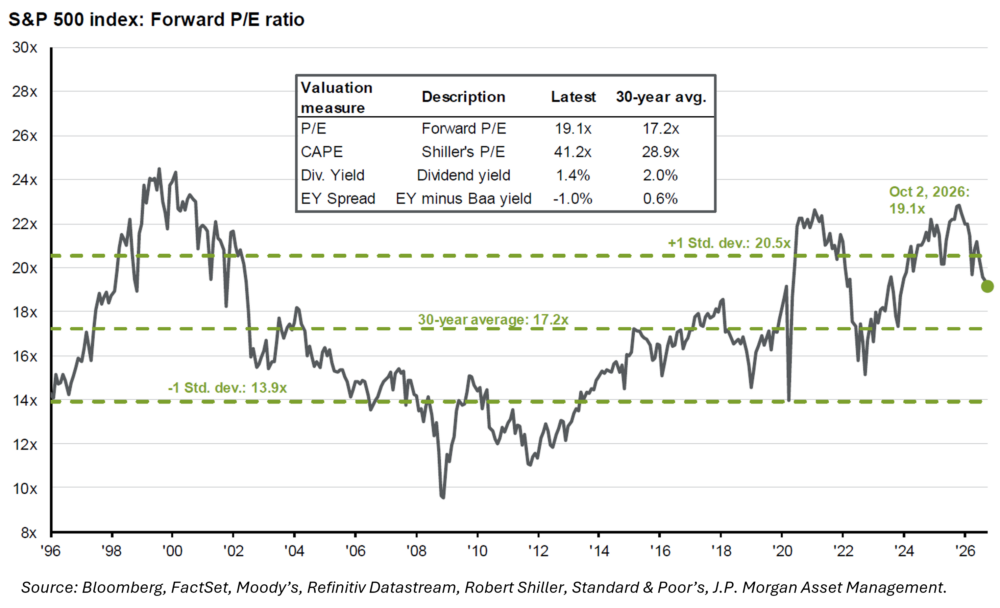
Economy in Focus: Accelerating Earnings Keep Valuations in Check
The stock market is having a difficult time keeping up with the impressive growth in earnings of the largest U.S. companies. A year ago, the P/E Ratio (the price investors pay for each dollar of earnings) of the S&P 500 Index was approaching historical highs. Today that multiple has settled at just over 19x, much closer to the 30-year average. This has given stock investors some breathing room as they consider taking on more risk in a rising rate environment. While earnings growth is expected to cool in 2027 and beyond, corporate and consumer spending appear to be resilient and look to provide support to a market that has already seen impressive gains in recent years.
At Garde, we employ risk management strategies, such as global diversification across and within asset classes, to help protect client portfolios and take advantage of volatility that will inevitably appear. A quarter in which equities rallied while bonds sold off is a reminder that the two asset classes don’t always move together, and that a well-built allocation can capture upside in stocks while using the current rate environment to lock in genuinely attractive income in bonds.
Tech Tip: Beware of Quishing (QR Code Phishing)
Scammers are increasingly embedding malicious links inside QR codes, placed on parking meters, restaurant menus, or even official-looking letters claiming to be from your bank or advisor. Scanning one can send you to a convincing fake login page designed to steal your credentials.
Action Item: Before scanning any QR code, especially one received by mail, email, or text, pause and consider the source. When in doubt, navigate to the organization’s website directly or call a number you already have on file rather than following a link from a scanned code.
As always, we are available as a resource on any of these topics. Please do not hesitate to reach out to us at any time with questions or concerns, and we look forward to connecting with you soon.
[1] https://advisors.vanguard.com/investments/products
[2] University of Michigan Surveys of Consumers – https://www.sca.isr.umich.edu/
[3] The Conference Board Consumer Confidence Index – https://www.conference-board.org/topics/consumer-confidence/
Please find this newsletter and others on our website at www.gardecapital.com.
This article was published by Garde Capital, Inc. a Seattle based Registered Investment Advisor that provides wealth management solutions to individuals and families, nonprofit organizations, and corporate retirement plans.
Copyright 2026 by Garde Capital, Inc.